The numbers, in full
Specifications
The line, what is in it, and the rules that apply in Wisconsin. Take this page to another company and ask them to match it line for line.
What is on this page, and what is not
Every figure here comes off the manufacturer’s sheet for the equipment we supply, and the exact model is named on your quote so you can check it. Where a figure depends on your house, the page says so rather than guessing.
If you are comparing quotes: ask for the model number, not the marketing name. And ask what salt dose a grain rating assumes. A softener advertised on a grain rating is quoting its maximum-salt number, and almost nobody runs a softener at maximum salt. The fair comparison is the cubic feet of media, the valve, and the salt setting.
The unit we stock, by the numbers
| Figure | Value | Notes |
|---|---|---|
| Media volume | 1.5 cu ft | Softening resin and coconut-shell carbon together, per the manufacturer’s packing list. Tank size alone does not decide capacity; the resin inside it does. |
| Sizing | sized to your water | Set from your hardness number and your household size. The quote names the model. |
| Media tank | 10″ × 54″ | Activated coconut-shell carbon over softening resin over a gravel underbed. |
| Brine tank | 15″ × 35″ | Square. Sits beside the media tank; this is what you add salt to. |
| Bypass | 1″ | Lets a plumber take the system out of circuit without cutting pipe. |
| Shipping weight | 125 lb | Plus 17 lb for the brine tank. Relevant to where it can go and who moves it. |
| RO storage | pressurized tank | Eleven and a half inches across and sixteen tall, so the tap is not waiting on the membrane. |
| RO drain line | required | Reverse osmosis sends part of the water it takes in to the drain. That is how it works, and you should know it before you buy one rather than after. |
| RO faucet | dedicated | Beside the main faucet, in four finishes. |
From the manufacturer’s specification sheets and packing list for this equipment.
The system we stock, and the builds we supply to order
The ZeroGrain One is softening resin and activated carbon in a single tank at the point of entry, plus the five-stage reverse-osmosis tap at the kitchen sink, for $3,950 installed. It is on our own pallet, we size it from your water and your household, and an independent licensed Wisconsin plumbing contractor makes the connections.
The rest of the line is supplied to order from the same manufacturer: the XL, the dual-tank city build, the dual-tank well build with its iron stage, the salt-free conditioner, the tankless reverse osmosis and the alkaline post-filter. A date promised on equipment that is not yet in hand is a date nobody can keep, so on these the install date is set once the equipment arrives and is approved for use in Wisconsin (SPS 384). Every build is on the systems page with the same kind of numbers as above.
Point of entry
The tank that does the work
One vessel, ten inches across and fifty-four tall, holding two layers: activated carbon over softening resin, on a gravel underbed. A brine tank sits beside it for the salt. It goes where the water enters the house, so everything downstream, from the water heater and the dishwasher to every fixture, gets treated water.
The valve is the part worth asking about. It is a ceramic-disc valve, and it regenerates on the volume you have actually used rather than on a clock. The complete written warranty comes with the quote, before you sign.
A tank size is not a spec. Ask any company for the cubic feet of media, the valve and the salt setting. Those three decide what it does, and a photograph of a cylinder tells you none of them. Ours are 1.5 cubic feet of resin and carbon, a ceramic-disc valve, and a salt setting worked out from your hardness. Ask us the same three questions, and ask whoever quotes you next.

The unit we supply, cut away: an illustration of this model, not a photograph. The model is named on your quote.

The reverse-osmosis unit, also an illustration rather than a photograph. Its model is named on your quote too.
Point of use
The tap the drinking water comes off
A five-stage reverse-osmosis unit under the kitchen sink, with a storage tank and its own dedicated faucet beside the main one. This is the tap that fills a glass, a kettle and a coffee maker, and for some owners the dog bowl, which is its own argument.
Sediment, then two carbon blocks, then the membrane, then a final polish on the way to the tap. Part of the water it takes in goes to the drain, which is how reverse osmosis works and is worth knowing before you buy one. The unit is sixteen inches wide, five and a half deep, eighteen tall; the storage tank is eleven and a half across and sixteen tall. Both fit in a standard sink base.
Filters are consumable and get changed on a schedule: every six to twelve months, depending on your water and how much you drink.
Pick one
The faucet, in four finishes
The dedicated tap is the only part of this system you will look at every day, so pick the one that matches the sink rather than the one that matches the tank in the basement. All four cost the same. There is no upgrade finish.

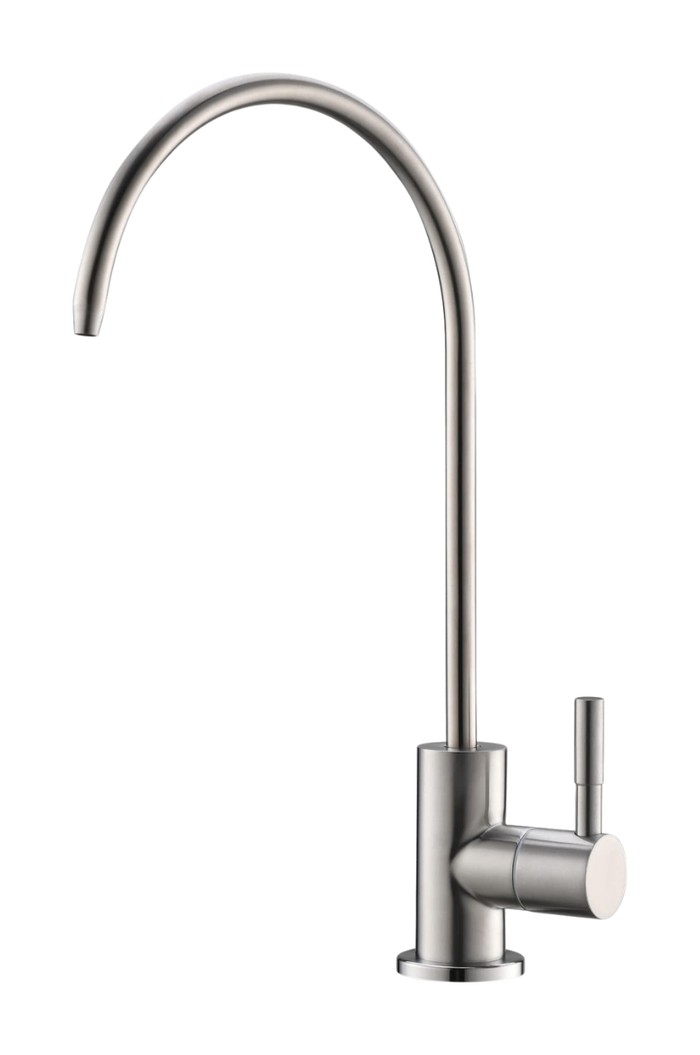

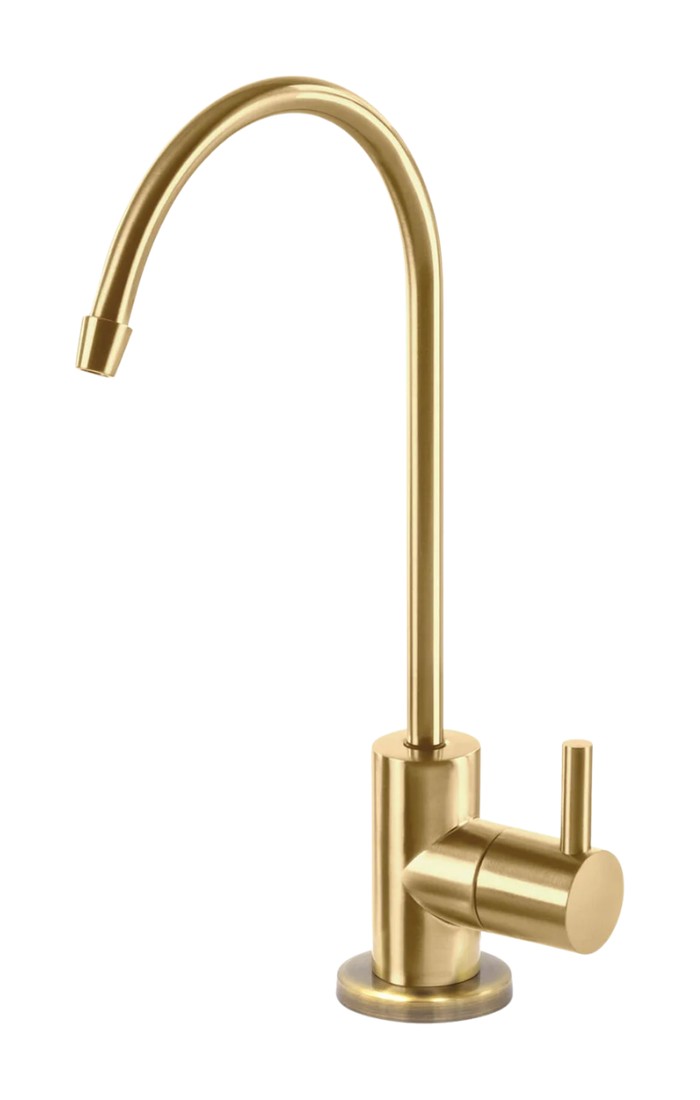
The system, stage by stage
| Stage | What it is | Notes |
|---|---|---|
| Point of entry: softening | Cation-exchange resin, demand-metered valve | Sized from your hardness, iron, household size and peak flow. The quote names the model. |
| Point of entry: filtration | Granular activated carbon | Included in the standard build. On the Standard and XL builds the carbon shares the softening vessel, layered over the resin. On a well, iron treatment takes this position and gets its own tank. |
| Point of use: drinking water | Reverse osmosis, under the kitchen sink | A dedicated tap beside the main faucet. The membrane has feed-water limits, and on most water around here they decide the whole design, as the section below explains. |
| Installation | Independent licensed Wisconsin plumbing contractor | Softener drain lines and RO reject lines run to a drain through an air gap, and Wisconsin treats that connection as plumbing (Wis. Stat. ch. 145). Any required permit is pulled in the plumber’s own name. |
| Device approval | Wisconsin DSPS product approval, required before install | Wisconsin requires approval of water treatment devices sold or installed in the state (Wis. Admin. Code ch. SPS 384), separately from any national listing. Install dates are set only for approved equipment. |

The line on the spec sheet nobody shows you
Reverse-osmosis membranes come with feed-water limits on hardness, iron, manganese, chlorine and pressure, and residential units in this class are commonly specified for feed water far softer than what comes out of the ground here. Hardness scales a membrane the same way it scales a water heater.
Read that against your own town. Brookfield publishes 23 to 34. Hartland’s Consumer Confidence Report calls its water approximately 23 grains. Germantown publishes 24. Cedarburg publishes 21 to 24.
On any of those, a softener ahead of the membrane is not an upsell attached to the reverse-osmosis order. It is how the membrane stays inside those feed-water limits. That is the whole reason the ZeroGrain One is one system instead of two products.
If anyone quotes you reverse osmosis alone for a 23-grain supply, ask them to show you the feed-water limits for the membrane they are selling, and ask whether your hardness is inside them. It is a fair question and it has a documented answer. Ask us the same one.
How the softener is sized
Four numbers, and the first one is published for most towns around here:
- Your hardness, in grains per gallon, from what your supply publishes or your well’s lab result, and read again at your tap on install day before anything is connected.
- Iron, because iron loads the resin and is treated ahead of it, not by it.
- Household size, which sets daily demand.
- Peak flow, which sets the valve and the tank diameter.
Multiply hardness by daily use and you have the grains the system removes each day, and that sets how often it regenerates. Size it too small and it runs out on a Saturday with a full house; size it too large and it wastes salt every week forever. That is why the quote starts with your number.
Three things you get in writing
“Trust us” isn’t a policy. These are.
Every one of these is written on the quote or the agreement, not a promise on a call.
Free quote, by phone
Every system starts with your number, not a catalog.
One short call, about fifteen minutes. We size from your town’s published number, or your well’s lab result, and your household, and you end the call with a one-page itemized quote.
- Free quote by phone
- Installed by a licensed WI plumber
- Softeners retested to zero