Waukesha County & the Milwaukee metro · $3,950 installed · free quote first, by phone

(262) 599-6261

Water softening & filtration · southeastern Wisconsin

Your water has a number.We leave you with zero.

Most town wells around here run 14 to 35 grains per gallon in published and state-sampled figures; Brookfield’s own utility publishes 23 to 34. Lake Michigan supply runs about 8. Either way it is hard water, and we are named for the number a softener leaves you with.

  • Free quote by phone
  • Installed by a licensed WI plumber
  • Every model named on the quote
  • Softeners retested to zero
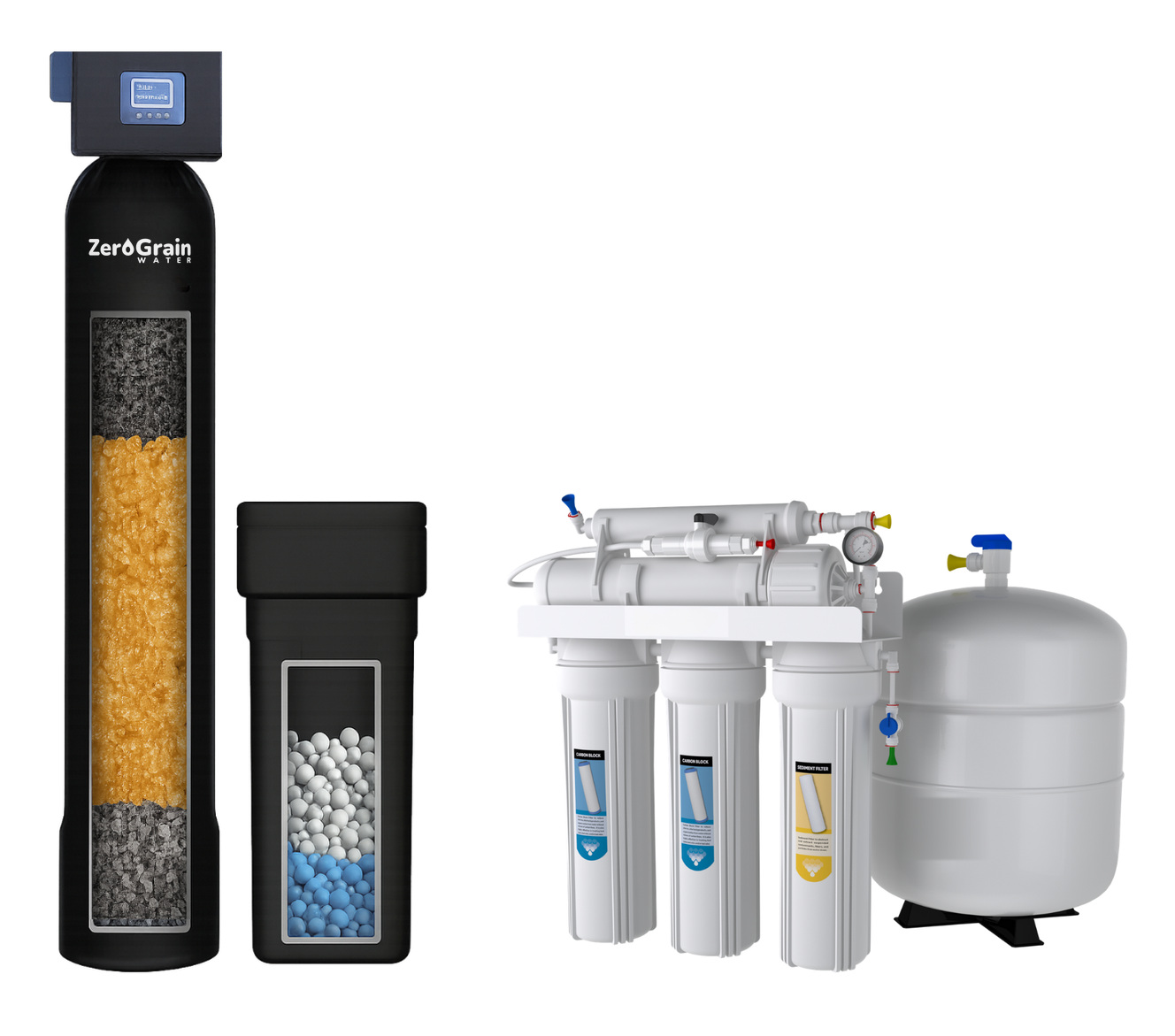
The ZeroGrain One: the whole-home tank with its brine tank beside it, and the five-stage reverse-osmosis unit with its storage tank $3,950installed
The ZeroGrain One Full specs → Whole-home softening and carbon in one tank, plus a five-stage reverse osmosis tap at the kitchen sink.

Why this matters

You already know something is off with your water

Nobody looks for a softener because they read a water quality report. They look because of one of these four things.

Scale on everything

White crust on shower heads and aerators, and a water heater quietly taking more energy every year. Scale is a thermal insulator sitting on the heating surface.

Glasses and towels that never come clean

Soap binds to hardness minerals before it can do its job, so glasses spot, laundry comes out stiff and whites go gray whatever you wash them with.

Your water heater works harder

Scale settles on the heating surface and insulates it, so the heater burns more to do less.

Spots on everything, iron in the sink

Hard water leaves the spotting and film on glassware and fixtures that never quite wipes off. County wells bring iron too, which comes up clear and turns orange in the sink.

The systems

Built for the water you actually have

City water and well water are different problems, and a 1,400-square-foot ranch and a 4,000-square-foot colonial are different problems. The system is sized from your water and your house, not from a price list.

See every system

How it works

Four steps, and the first two cost nothing

We would rather tell you the number does not justify a system than sell you the wrong one. It is a strange sales pitch, and it is the whole business.

  1. 1
    We call

    One short call, about fifteen minutes. Your town’s published hardness, your household, where the main comes in. On a well, any lab result you already have.

  2. 2
    We quote

    One page, itemized, good for 30 days, with every model named. Take it, compare it, sleep on it.

  3. 3
    A licensed plumber installs it

    A scheduled visit on a date you pick once the equipment is in hand and approved for use in Wisconsin (SPS 384). Wisconsin-licensed contractors working under a responsible master plumber, who pull any required permit in their own name.

  4. 4
    Softeners: tested at the tap, then retested to zero

    On a softener install, before anything is connected and again once it is, with you watching the second number land.

Get your free quote

Takes about thirty seconds. We call you back the same or next business day.

Water source
If you are not sure, leave it blank. We sort it out on the call.

We reply the same or next business day and never resell your information. Prefer email? support@zerograinwater.com

The ZeroGrain One: the whole-home tank with its brine tank beside it, and the five-stage reverse-osmosis unit with its storage tank

Why zero

The number is the whole promise.

Hardness is not an opinion. It is a figure your utility publishes, or a figure a lab returns off your own well, and every honest decision about a system starts there. That is why the first thing this company does is read your number back to you.

And it is why a softener install does not end when the tank is plumbed in. It ends with your tap, tested before the install, retested after it for zero grains per gallon.

In writing

Three things you get in writing

Every one of these is written on the quote or the agreement, not a promise on a call.

Read the FAQ

3 days

To change your mind

Three business days to cancel after you sign. Two copies of the cancellation notice come with the contract, filled in and dated.

0

Balance due before the install is complete

The agreement puts full payment at the completion of the install: the system in, running and your water retested at your tap.

30 days

The quote holds

One itemized page with every model named, so you can compare it against anyone.

A closer look

The equipment, up close

The system in product renders: the softening tank and its brine tank, the drinking-water tap, and what is inside the tank, on one sheet.

Full specifications
The ZeroGrain One: the whole-home tank with its brine tank beside it, and the five-stage reverse-osmosis unit with its storage tank
The ZeroGrain One softening tank with its control valve, and the closed brine tank beside it
The five-stage reverse-osmosis unit with its storage tank and its dedicated brushed-nickel drinking-water faucet
The ZeroGrain One specification sheet, showing the whole-home tank cut away to its media (1.5 cubic feet of resin and carbon in a 10 by 54 inch tank), its brine tank, and the five-stage reverse-osmosis unit

Where we work

Thirty-three towns, four counties

Every town we work in has its own page carrying that town’s utility, its source and its published hardness, not a regional average. Where a town publishes nothing, the page says so instead of guessing. The fullest of those pages is water softeners in Waukesha, where the lake-water switch and the city’s softener rule both apply.

Waukesha County

Twelve towns, and no single number covers them. Brookfield publishes 23 to 34 grains and Hartland about 23 from their own wells; Waukesha and most of Menomonee Falls run about eight on purchased Lake Michigan supply. And the 40,000-plus private wells the county itself counts answer to nobody’s annual report.

Towns we serve →

Milwaukee County

Most of the towns we serve here run on Lake Michigan water. Milwaukee Water Works and the North Shore Water Commission both publish about eight grains, the softest tap water in this market, and Milwaukee’s utility says softeners are not necessary for residential use. So the honest first step is usually a drinking-water tap. Oak Creek and Franklin publish no figure at all, and River Hills is still mostly on private wells.

Towns we serve →

Ozaukee County

Cedarburg publishes 21 to 24 grains out of deep wells and says outright that it does not soften, and Grafton’s wells run about 22. The Mequon Water Utility sells Lake Michigan water, about eight grains, to connected homes in Mequon and Thiensville, and most of Mequon is on private wells. Port Washington treats its own lake water and publishes no figure.

Towns we serve →

Washington County

Some of the hardest published water in the region and some of the least documented. Germantown publishes 24 grains across six wells, West Bend’s sewer utility gives 25 to 31 as the right softener setting, and Hartford’s own figure is 18 to 22. Richfield has no utility at all: the whole village is on private wells, by the Village Board’s own choice.

Towns we serve →

Questions

The things people ask us

Anything that is not here, just ask it on the call. The person sizing the system is the person who knows.

All questions →

Waukesha switched to Lake Michigan water. Do I still need softening?

City of Waukesha taps now run about 8 grains: much softer than the old 20-plus, but still “hard” on the USGS scale. Homes on private wells didn’t switch anything. Either way the quote is free and the number decides, not us.

What does a system cost?

$3,950 installed for the ZeroGrain One: softener, activated carbon and the reverse-osmosis drinking tap, installed by an independent licensed Wisconsin plumbing contractor who pulls any required permit. Installation is in the price, not added to it. It is our only price, and the quote holds it for 30 days. The call checks it against your house first: your hardness, whether iron is along for the ride, and your household size.

Is soft water safe to drink?

Softening removes hardness minerals; it is not a safety treatment and we will not market it as one. For drinking water, the reverse-osmosis stage puts a dedicated filtered tap at your sink. If you’re on a private well we also recommend the state-certified lab tests for bacteria and nitrates. We can point you to them, and they are not something we sell. Reverse osmosis is not a safety treatment either; what it is rated for is on the manufacturer’s sheet for the model on your quote.

How much salt does a softener actually use?

That is arithmetic, not a measurement: hardness times daily use gives the grains the resin removes each day, and the salt follows from how often it regenerates. How much you use depends on your hardness, your household and the salt setting, and the call works it out from your number. Oversized or timer-based units use more, which is one reason we size from your actual water instead of selling one tank to everyone.

Who does the installation?

Independent licensed Wisconsin plumbing contractors, working under a responsible master plumber, who pull any required permit. Softener drains and RO lines are real plumbing, and Wisconsin law treats them that way.

How long does installation take?

A typical single-family install is a morning’s work. It is scheduled once you have signed, the equipment is in hand and has Wisconsin product approval (SPS 384), on a date you pick, and your three-business-day cancellation window runs first.

Free quote, by phone

Find out what your water actually reads

One short call, about fifteen minutes. We size from your town’s published number, or your well’s lab result, and your household, and you end the call with a one-page itemized quote.

  • Free quote by phone
  • Installed by a licensed WI plumber
  • Softeners retested to zero